
For two and a half years now, Moscow has been implementing the UrbanTransportData international analytical project (the project’s web platform is available at https://urbantransportdata.ru/), which brings together leading cities around the world to work with open transport data. The project is aimed at making urban transport systems more convenient, predictable and efficient for residents and visitors of large metropolitan areas. The initiator and developer of the project is the Moscow Transport Complex, which has independently developed both the methodology and the digital service without engaging external contractors.
Not only about data, but also about people.
UrbanTransportData is based on the idea that high‑quality transport policy is impossible without reliable, comparable and regularly updated analytics. The project targets managers and staff of transport authorities, experts and researchers, as well as students and urban transport enthusiasts from around the world.
The project team emphasizes that the goal of UrbanTransportData is not simply to collect statistics, but to help cities understand which solutions actually work and which need adjustment. To this end, convenient tools are being created to compare cities with one another, identify trends and track innovations that have already delivered results in practice.
Three pillars of UrbanTransportData
The project is based on three key components: a data aggregation system, a news portal and a knowledge base with research. The first two components are already fully available on the project’s web platform.
As part of data aggregation, indicators related to urban transport are collected and aligned in a systematic way, ranging from infrastructure parameters to passenger flows.
The news portal reports on the latest changes in the transport systems of participating cities, new projects and technological solutions, and provides an up‑to‑date picture of the sector.
The knowledge database will include thematic reviews and the results of joint studies, as well as a professional Q&A forum where experts will be able to exchange experience and data directly. This section is currently being prepared for launch.
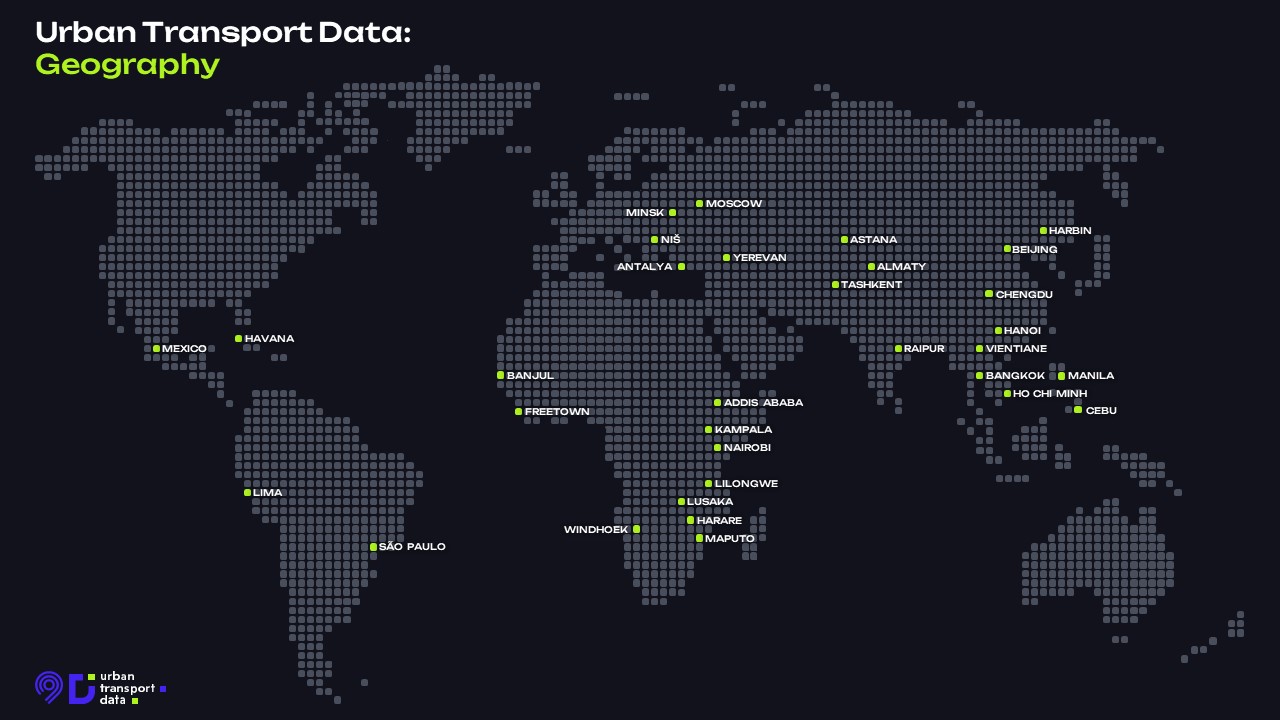
32 participating cities.
The UrbanTransportData project already unites 32 cities in Europe, Asia, Africa and the Americas, including recognized regional leaders in urban transport development such as Moscow, Beijing and São Paulo. The project’s broad geography also includes capitals of African countries, European cities and other major metropolitan areas in Latin America.
Such diversity of participants allows to compare not only megacities with millions of residents, but also fast‑growing capitals of developing countries, identifying common challenges and unique solutions. For participants, this approach provides an opportunity both to share their own experience and to obtain new ideas from cities with different layouts, climates, levels of motorization and socio‑economic conditions.
Focus on methodology.
One of the distinctive features of UrbanTransportData is its emphasis on methodological accuracy. The project’s team of analysts works through in detail how exactly key indicators should be calculated so that data from different cities can be compared correctly. Data is collected for 50 indicators covering several thematic blocks.
A separate area of work involves unifying approaches. For example, for metro systems it is clarified whether single‑track or double‑track kilometers are taken into account, whether operational or technical tracks are included, and whether one or several operators are considered. When analyzing ridership, it is important to determine whether all validations are counted or only unique passengers, whether only entries or also exits are recorded, and whether weekends are included. This level of detail makes it possible to move away from superficial comparisons and move towards truly comparable data that can be used in strategic planning.
Evidence‑based planning.
From the outset, UrbanTransportData has been building a network of cities ready to base their transport policies on data rather than intuition. In the long term, the project may become one of the key international platforms where decisions are made on how public transport and urban mobility will develop in the coming decades.