
Rosneft Summarises Results of White Sea Ecological Project

Source: Rosneft – An important disclaimer is at the bottom of this article.

Specialists from Rosneft’s Arctic Research Centre and scientists from the country’s leading research institutions summed up the results of a large-scale ecological project in the White Sea. The project was implemented jointly with the non-governmental development institute Innopraktika, with participation from Moscow State University’s Marine Research Centre, Moscow State University’s Faculty of Biology, St Petersburg State University, the P.P. Shirshov Institute of Oceanology of the Russian Academy of Sciences, the Zoological Institute of the Russian Academy of Sciences, and the Biotechnology Campus Centre for Whole Genome Sequencing.

The research, which began in 2023, comprised two field seasons aboard the research vessels Kartesh and Professor Zenkevich, as well as unique laboratory work. Project participants retraced the route of expeditions conducted between 1922 and 1926 by the prominent Soviet hydrobiologist Konstantin Deryugin, who provided detailed descriptions of the White Sea’s flora and fauna.

Rosneft’s project aims to analyse century-long changes in the region’s marine ecosystems using both Deryugin’s methods and modern technologies, whilst assessing the impact of natural and anthropogenic factors on Arctic ecology.  This information is essential for long-term planning of sustainable development in Russia’s north.

At a press briefing, scientists shared preliminary findings. Specialists concluded that the White Sea ecosystem remains stable,  allowing the region to serve as a reference point for comparison with other Arctic territories.

However, the research revealed insufficient understanding of Arctic marine fauna: up to 30 per cent of species retain uncertain taxonomic status, indicating considerable work remains in revising the fauna of Arctic seas.  Nevertheless, specialists succeeded in describing species new to science.

Scientists employed both traditional hydrobiology equipment and cutting-edge instruments and innovative technologies. They surveyed the White Sea floor using remotely operated unmanned underwater vehicles and conducted molecular genetic analysis of discovered organisms.  For this work, they deployed the world’s only DNA sequencer located beyond the Arctic Circle.

For reference:

Rosneft implements the most ambitious program for studying the Arctic region since Soviet times. Over the past 13 years, over 60 expeditions have been carried out to study the hydrometeorological, geological and biological features of the region, as well as bioindicator species of Arctic ecosystems. It has been the source of a unique body of information on Arctic climate, nature and wildlife. Based on the research results, several ecological atlases have already been created: “Seabirds of the Russian Arctic”, “Species – biological indicators of the state of Arctic marine ecosystems” and “Marine Mammals of Russia”, “Kara Sea”, “Laptev Sea”, “Barents Sea” and others.

Department of Information and Advertising
Rosneft
December 10, 2025

Please note; this information is the raw content received directly from the information source. This is exactly what the source claims and does not necessarily reflect the position of MIL-OSI or its clients.
Rosneft Holds Corporate Tennis and Badminton Competitions

Source: Rosneft – An important disclaimer is at the bottom of this article.

Rosneft held corporate competitions in badminton and table tennis. The second Rosneft Racket tournament took place yesterday at the Zenit sports complex in Krasnogorsk. The competition brought together athletes from the Company’s 33 subsidiaries from across the country.

Promoting a healthy lifestyle is a key component of Rosneft’s social policy. The Company is developing the Energy of Life sports and fitness movement, which involves employees in regular sports and various competitions.

During the two-day tournament, participants competed in individual and team (consisting of one woman and one man) events.

The RN Moscow team won the mixed doubles category in big tennis, and an RN-Yuganskneftegaz employee won the individual tournament. The Company’s Central Administration Office representatives took the lead in badminton, while RN-Uvatneftegaz took the lead in table tennis. After two days of competition, the RN-Yuganskneftegaz team was top of the team standings.

Congratulations to the winners and participants of the Rosneft Racket corporate competition!

For reference:

The Energy of Life corporate programme unites over 128,000 Company employees. Over 92,000 people take part in a variety of sports competitions, including company-wide competitions and contests, as well as regional and national competitions.

As part of the Energy of Life programme, Rosneft is carrying out extensive information and organisational work to develop a mass sports movement among its employees and engage them in a healthy lifestyle. Sports training is organised for employees. The number of oil workers who are actively involved in sport is increasing year on year.

Department of Information and Advertising
Rosneft
December 15, 2025

Please note; this information is the raw content received directly from the information source. This is exactly what the source claims and does not necessarily reflect the position of MIL-OSI or its clients.

Rosneft Initiates “Auto-Tourism: Russian Horizons” Category

Source: Rosneft – An important disclaimer is at the bottom of this article.

Rosneft has partnered with the Russian Traveler Awards 2025 to establish a new category, “Auto-Tourism: Russian Horizons.” Award ceremony for winners and runners-up held in Moscow.

Russian Horizons” category was specifically tailored for independent travelers who chart their routes through Rosneft’s filling station network.

Rosneft is actively promoting the development of domestic tourism and is building its “Russian Horizons: Come with us”, a digital platform offering ready-made routes and the ability to design your own trips based on Rosneft’s road infrastructure. Since 2023, the Company, in collaboration with its partners, has already introduced over 50 routes spanning 24 regions of the country.

Following a public vote, the winner of the Rosneft category was the “From Central Russia to the Heart of Parma” route. The journey takes travelers from the Tambov region to the Perm region, visiting the locations that served as the natural film sets for the feature film The Heart of Parma.

Spanning a total distance of 4,400 km, the route passes through Ulyanovsk, Solikamsk, Perm, and Izhevsk, encompassing dozens of local attractions and natural, historical, and architectural monuments. Rosneft presented a special prize for this unique itinerary to the family of Sergey Forofontov, a first responder from Tambov.

For the fourth consecutive year, the Russian Traveler Awards have recognized the country’s leading achievements in tourism. The awards aim to highlight Russia’s most compelling offerings, from iconic landmarks and unique travel routes to authentic traditions and vibrant festivals. The initiative helps redefine the Russian tourism map and encourages the discovery of new destinations.

For reference:

Rosneft’s retail network is the largest in Russia in terms of geographical coverage and number of filling stations. The Rosneft filling station brand is one of the leaders in Russia in terms of recognition and fuel quality. The Company operates approximately 3,000 filling stations.

Department of Information and Advertising
Rosneft
December 9, 2025

Please note; this information is the raw content received directly from the information source. This is exactly what the source claims and does not necessarily reflect the position of MIL-OSI or its clients.

RN-Vankor Increases Power Capacity at Tagulskoye Field

Source: Rosneft – An important disclaimer is at the bottom of this article.

RN-Vankor, part of Rosneft’s oil and gas production complex, has commissioned a 110/35/10 kV Tagul substation with a capacity of 2х63 MVA. The facility will ensure reliable power supply to sites at the Tagulskoye field, which is part part of the Vankor cluster.

Power is supplied to Tagul from the 150 MW Polyarnaya gas turbine power station at the Vankor field. A 110 kV transmission line spanning more than 70 km has been built to connect the power station with the Tagul substation.

Construction of the substation was accelerated through the installation of prefabricated structures.  The building contains power transformers, enclosed switchgear for 35 kV and 10 kV, and is equipped with a control centre.

The domestic engineering solutions applied at the Tagul substation have been proven by the successful operation of the Vankor energy complex in Far North conditions. The switchgear design remains operational even if individual components fail, enhancing overall reliability of power supply to the field’s oil production facilities.

Tagul is the eighth 110 kV substation at the Vankor cluster fields. Two further similar substations are in the final stages of installation. The total length of overhead power transmission lines already exceeds 1,900 km.  The largest substation, Vankor, with a capacity of 250 MVA, connects the Vankor energy district to the country’s Unified Energy System.

Department of Information and Advertising
Rosneft
December 16, 2025

Please note; this information is the raw content received directly from the information source. This is exactly what the source claims and does not necessarily reflect the position of MIL-OSI or its clients.

“The Mountains Are Calling!” — Rosneft’s winter route in the South Urals

Source: Rosneft – An important disclaimer is at the bottom of this article.

Rosneft and the Ministry of Entrepreneurship and Tourism of the Republic of Bashkortostan presented a winter car route called “The Mountains Are Calling!”.

The route was presented at Bashneft filling stations in Ufa (Rosneft subsidiary). Company representatives, professional skiers and tourism and hospitality experts told about the locations and programme of the route, which combines active winter sports, family entertainment and visits to protected areas.

Rosneft is committed to the development of domestic tourism and aims to create comfortable conditions for car travellers. One of Rosneft’s key objectives is to enhance the quality of its roadside assistance and customer service at its filling stations.

The car route runs from Ufa to the slopes of the Southern Urals for around 500 kilometres. There are 16 Bashneft filling stations along the route at an optimal distance. At filling stations, travellers can fill up their cars with guaranteed-quality fuel and enjoy a comfortable rest in the café. They can also purchase goods needed for their journey, including locally produced items.

Mount Malinovaya is the first point of interest. Its peaks and snow-covered slopes are popular with snowboarders and skiers. The location is popular throughout the year. The mountain is regarded as one of the accessible “thousanders” and there are designated routes for hiking ascents.

The next stop on the route is the Mratkino ski centre, which is located close to Beloretsk. The modern artificial snowmaking system provides optimal skiing conditions from November to mid-April. The resort has slopes of various difficulty levels, suitable for both beginner and professional skiers and snowboarders. The centre’s infrastructure offers a variety of opportunities for family recreation.

The Abzakovo ski resort is known for its well-developed advanced infrastructure, making it the perfect place to continue an active holiday. The resort has various pistes that together span a total length of 18 kilometres. The slopes offer picturesque panoramic views of the Ural Mountains. The ski season here starts in November and runs until May.

The next destination on the route is the Yaky-Kul mountain lake. The Bannoye ski centre is located on the coastline. The resort offers guests the opportunity to ski on nine slopes, which have a total length of around 10 kilometres. To ensure a comfortable ascent to the Yamankaya Ridge, a high-speed gondola lift operates on the slope.

The route offers visitors the opportunity to explore another attraction: the Kuzhanovskiye Larches, a botanical natural monument of regional importance. The youngest larch is 65 years old, while the oldest is around 160 years old. The larches have an unusual dense oval crown and are distinctive in the surrounding mixed forests.

A tour to the White Healer multi-breed kennel is the perfect way to finish the journey. There will be lectures from kinologists on the secrets of dog breeding, and guests will be able to play with puppies.

The “The Mountains Are Calling!” car route is the fourth tourist project developed by Rosneft in collaboration with the Ministry of Entrepreneurship and Tourism of the Republic of Bashkortostan. As part of the Russian Horizons project, the Power of Nature interregional route opened in 2024, followed by the Pavlovskaya Roundabout and the Kama Necklace in 2025.

For reference:

Rosneft is actively promoting the development of domestic tourism and is building its “Russian Horizons: Come with us”, a digital platform offering ready-made routes and the ability to design your own trips based on Rosneft’s road infrastructure. Since 2023, the Company, in collaboration with its partners, has already introduced over 50 routes spanning 24 regions of the country.

Department of Information and Advertising
Rosneft
December 11, 2025

Please note; this information is the raw content received directly from the information source. This is exactly what the source claims and does not necessarily reflect the position of MIL-OSI or its clients.

Rosneft’s Samara Enterprises are Winners of Social Efficiency Contest

Source: Rosneft – An important disclaimer is at the bottom of this article.

The Kuibyshev Refinery and the Novokuibyshevsk Refinery, both enterprises of Rosneft’s Samara Refineries Group, have been awarded first prize in the XXV All-Russia Contest “Russian Organisation of High Social Efficiency”. Tatyana Golikova, Deputy Prime Minister for Social Policy, presented the awards to representatives of enterprises at the All-Russian Personnel Forum in Moscow.

The Novokuibyshevsk Refinery was awarded first place in the category “For Social Partnership Development in Industrial Organisations”. The Kuibyshev Refinery was awarded second place in the nomination “For support of employees – large families among industrial organisations”.

The refineries’ social programmes include voluntary medical insurance, health resort recuperation in Russian health resorts, maternity support, sports activities in 30 sections and health groups, corporate mortgage lending and assistance in resolving housing issues for young specialists and non-resident employees, as well as a corporate pension programme. Employees’ families are offered preferential trips to the refinery’s health resort, children’s camp, and recreation centre on the Volga River.

For reference:

The Ministry of Labour and Social Protection of the Russian Federation has been organising the annual Russian Organisation of High Social Efficiency competition for 25 years. The competition consists of two rounds: regional and federal. The jury consists of tripartite commissions that regulate social and labour relations. This year, the competition attracted over 1,400 employers from 74 regions of the country.

Department of Information and Advertising
Rosneft
December 10, 2025

Please note; this information is the raw content received directly from the information source. This is exactly what the source claims and does not necessarily reflect the position of MIL-OSI or its clients.

Udmurtneft Expands Power Supply to Promising Oil Production Facilities

Source: Rosneft – An important disclaimer is at the bottom of this article.

Udmurtneft (part of Rosneft’s oil production complex) has commissioned a two-transformer Yelnikovo electric substation. The substation has a 35 kV voltage class and a total installed capacity of 32 MVA. It will ensure a reliable power supply for the existing and prospective oil production facilities of the Yelnikovskoye field.

During the reconstruction of the substation, more powerful transformers were installed and a system of online diagnostics of their technical condition was introduced. All equipment is of Russian manufacture and meets the latest energy efficiency and industrial safety requirements. The automated diagnostic system provides real-time control of the equipment, enabling prompt monitoring of operations and correction of any changes in processes.

The upgraded substation will provide power supply to the growing drilling volumes at the prospective Yelnikovskoye field and new production facilities being commissioned. Plans have been announced to construct 18 new wells in the area by the end of 2026 alone.

Earlier, Udmurtneft commissioned the newly built Kotovo electric substation, which has an installed capacity of 20 MVA, as well as a 110 kV double-circuit transmission line stretching over 30 kilometres. The 110 kV Sokolovka electrical substation has also been upgraded, increasing its installed capacity to 80 MVA.

Improvement of production asset efficiency is one of the key components of the Rosneft Strategy. The Company and its subsidiaries carry out systematic work aimed at rational use of resources, optimisation of electricity consumption, and distribution of electricity loads.

Following a nine-month energy saving programme in 2025, Udmurtneft succeeded in saving more than 24 million kWh of electricity. The economic gain is around 157 million roubles.

For reference:

Udmurtneft is the largest oil-producing enterprise in the territory of Udmurtia, providing 60% of crude produced in the region. It develops 36 fields located in 14 districts of the republic. Cumulative oil production of the enterprise exceeds 340 million tonnes of oil.

Department of Information and Advertising
Rosneft
December 9, 2025

Please note; this information is the raw content received directly from the information source. This is exactly what the source claims and does not necessarily reflect the position of MIL-OSI or its clients.

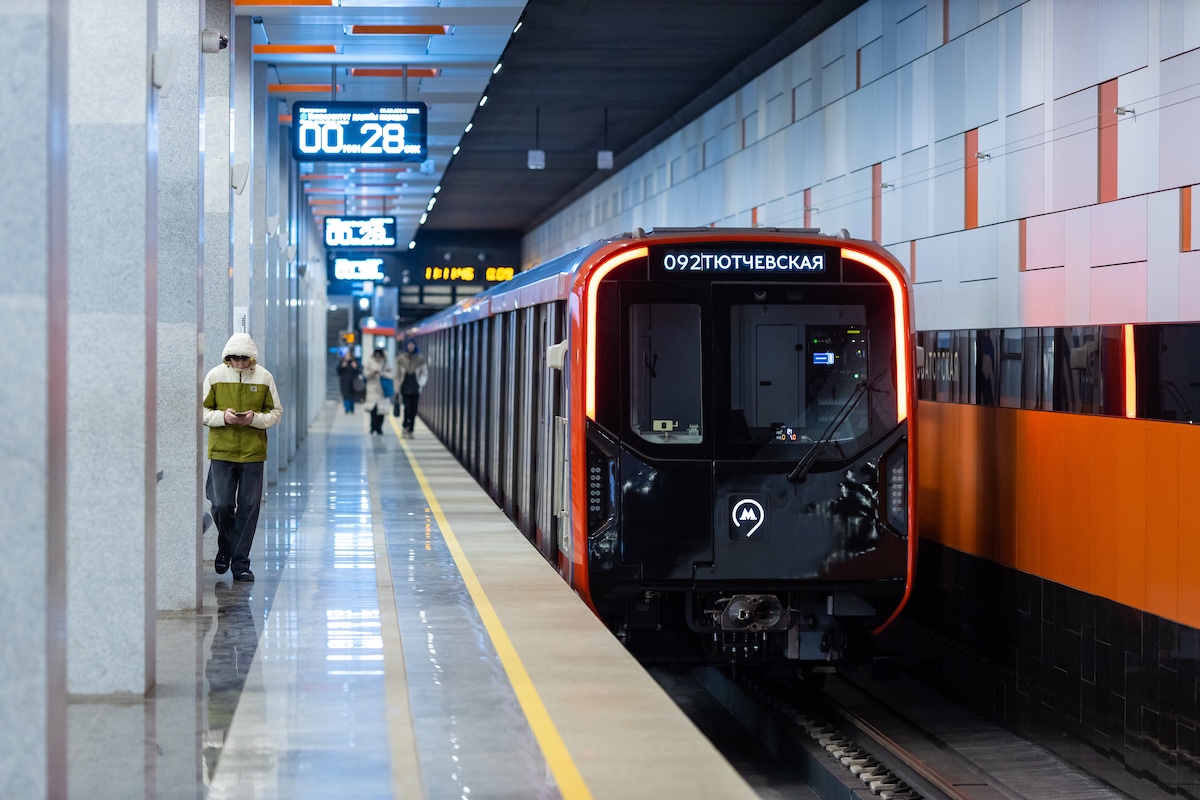
Moscow Metro has launched the new Moskva-2026 train.

A new high-tech train of the Moskva-2026 series has entered service on the Line 2 of the Moscow Metro.

The modern trainset was developed and manufactured at the Metrowagonmash plant using domestically produced components.

Before entering passenger service, the train underwent comprehensive test runs without passengers. Specialists thoroughly checked the operation of all systems and mechanisms, examining every detail.

The new Moskva-2026 series retains the key advantages of previous generations: powerful air conditioning systems, wide doors, comfortable inter-car passageways, and adaptive lighting.

The train’s capacity has been increased by 10% compared to conventional numbered trainsets, and door width has grown by 32%.

Engineers have further enhanced passenger ergonomics and comfort.

The new train features larger glazing in entrance areas, upgraded rear-view cameras, and an improved passenger–driver communication system.

Seats are now seamless, without metal joints, and the air conditioning system includes additional ceiling-mounted air ducts.

Lighting in the end cars has also been completely redesigned.

The Moskva-2026 represents a significant step forward in the development of Russia’s domestic rolling stock industry.

Today, this train can rightfully be considered one of the most advanced and comfortable metro cars in the world.

2025 — The Year of the Moscow Tram: The capital has launched its second catenary-free tram line, and Tram No. 5 has returned to its historic route between Belorussky Railway Station and Rizhskaya Metro Station.

Moscow, December 16, 2025 — The year 2025 will rightly go down in history as a landmark year for breakthrough developments in Moscow’s tram system. The city has implemented several key projects that will shape the future of this mode of urban transport for decades to come. These include the launch of Russia’s first fully autonomous tram, the commissioning of catenary-free tram segments for battery-powered vehicles, and the inauguration of Moscow’s first Tram Diameter (MTD).

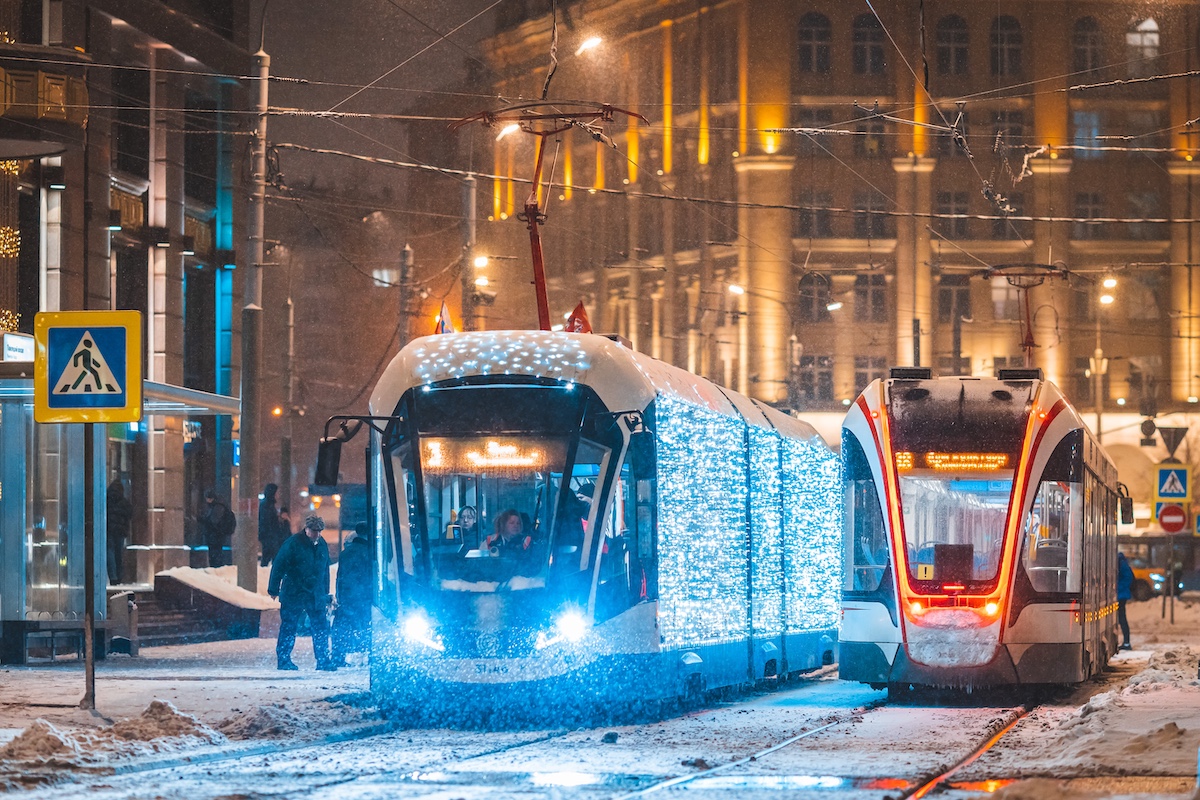
Today, December 16, 2025, these achievements were further enhanced with the opening of Moscow’s second catenary-free line—marking the return of Tram No. 5 to its route along Trifonovskaya Street, connecting Belorussky Railway Termunal and Rizhskaya Metro Station, after a 30-year absence.

To implement this project, specialists from the Moscow Metro undertook extensive reconstruction work: rails, sleepers, and the entire track surface were completely replaced. New tram tracks have been laid along Giljarovskogo Street between Trifonovskaya Street and Rizhskaya Square, and a modern turning loop has been installed near Rizhskaya Metro Station.

State-of-the-art seamless rail-laying technology was used, incorporating rubber seals and specialized vibration-dampening mats. This ensures quiet, smooth tram operation—enhancing comfort for both passengers and residents of neighboring streets. The new segment has been fully integrated into Moscow’s existing tram network, with three rail switches at the intersection of Trifonovskaya and Obraztsova Streets completely modernized.

Tram route No. 5 is operated by modern Lvyonok-Moskva trams. These vehicles travel over 4 kilometers—from Obraztsova Street to Rizhskaya Metro Station and back—entirely on battery power, without needing overhead wires.

“2025 has truly been a transformative year for Moscow’s tram system. We’ve not only launched Russia’s first autonomous tram and the first Moscow Tram Diameter—we’ve also continued expanding our infrastructure, bringing trams back to neighborhoods where they haven’t run for decades. The opening of the line along Trifonovskaya Street is a significant step forward, demonstrating the effectiveness of battery-powered operation and the city’s commitment to building a modern, comfortable, and eco-friendly transport system for Muscovites,” said Maksim Liksutov, Deputy Mayor of Moscow for Transport.

Beyond transport infrastructure, comprehensive urban improvements have been carried out along Trifonovskaya Street and adjacent areas. Rizhskaya Square now features a welcoming public space with landscaped greenery and cozy seating areas—significantly enhancing the overall urban environment.

Looking ahead, plans include launching Moscow’s second Tram Diameter (T2), running from Novogireyevo MCD station to Chertanovskaya Metro Station, as well as further expansion of the tram network. Priority projects include extending lines along Entuziastov Highway into the Ivanovskoye District and along Akademika Korolyova Street to the Ostankino TV Center and Ostankino MCD station—making the tram network even more accessible and extending service to new areas of the capital.

About the Moscow Tram:
The Moscow tram is one of the city’s oldest and most dynamically developing public transport systems. In recent years, Moscow has actively pursued ambitious projects to modernize and expand its tram network, introduce cutting-edge technologies, and improve passenger comfort—solidifying its status as a global leader in smart urban mobility.

The Moscow Tramway Diameter T1 transported more than 1.8 million passengers in its first month of operation.

The new Moscow Tramway Diameter T1, connecting Metrogorodok and the Universitet metro station, transported more than 1.8 million passengers in its first month of operation. The route length is 27 kilometers, making it the longest urban tramway diameter in the world.

The T1 tramway diameter covers 13 districts of the capital, providing convenient access to 24 metro stations, the Moscow Central Circle (MCC) and Moscow Central Diameters (MCD), as well as four railway stations. The line is operated by about 50 modern Lvyonok-Moskva trams, equipped with an autonomous drive system, which allows for maintaining a stable interval of just 6 minutes between trains.

Thanks to the launch of T1, travel times in the central part of the city have been reduced by 20%. The new diameter has become a comfortable and efficient mode of transportation for more than a million residents of the capital.

“The Moscow Tramway Diameter T1 has demonstrated impressive results in its first month of operation. Moscow Mayor Sergey Sobyanin said that T1 trams have already made more than 10 thousand trips and traveled over 270 thousand kilometers. This transport solution has proven its popularity among passengers. We have seen that autonomous trams are reliable, comfortable and safe,” noted Moscow Deputy Mayor for Transport Maksim Liksutov.

The success of the first tramway diameter confirms the promising development of this transport model. In the spring of 2026, the launch of the second tramway diameter is planned in the capital, which will connect the MCD station Novogireevo with the Chertanovskaya metro, continuing the expansion of comfortable and modern urban infrastructure.

About the Moscow Tramway Diameter T1:

The Moscow Tramway Diameter T1 is a new project for the development of urban transport in Moscow, designed to improve transport accessibility and reduce travel time for residents of the capital. It is a modern tramway line with a high level of service and the use of advanced technologies.